


Hydraulic Safety & Reliability Solutions
Hydraulic safety and reliability depend on connection integrity, pressure management, contamination control, proper coupling selection, and consistent operating practices. Couplers, adapters, hoses, caps, plugs, pressure-management components, and multi-coupling systems all influence how safely and reliably hydraulic equipment performs during operation, service, transport, and attachment changes.
Stucchi supports hydraulic connection strategies that help reduce fluid loss, manage residual pressure, prevent misconnection, control contamination, and improve uptime across mobile equipment, OEM systems, industrial machinery, and demanding fleet environments.
Hydraulic systems operate under high pressure, making connection design and maintenance practices critical to safe operation. According to OSHA, hydraulic injection injuries can occur when high-pressure hydraulic fluid penetrates the skin, creating a serious medical emergency that may look minor at first but can lead to severe tissue damage if not treated quickly.
Why Hydraulic Safety Starts at the Connection Point
Hydraulic connection points see some of the highest-risk activity in the system. Lines are connected and disconnected; pressure is managed; couplers are cleaned and capped; and attachments are changed, transported, stored, and serviced. When the connection setup does not align with the system’s pressure, flow, environment, equipment design, or operator workflow, routine work can pose unnecessary risk.
Reliability problems often start with small connection issues: residual pressure that makes lines difficult to connect, fluid release during disconnection, contamination entering the circuit, undersized couplers that contribute to heat and pressure drops, or multi-line setups that increase the risk of misconnection.
A safer hydraulic connection strategy considers the full operating environment. That includes how the equipment is used, who makes the connections, how often attachments change, what pressure conditions are present, and how the machine is stored, transported, and serviced between uses.
Common Hydraulic Safety Risks at Connection Interfaces
Hydraulic safety risks often appear during routine work. Attachment changes, line disconnection, maintenance, transport, and troubleshooting can expose operators and equipment to connection-related hazards.
Common risks include:
- Hydraulic fluid injection from pinhole leaks or pressurized discharge
- Hose whip caused by sudden hose or coupling failure
- Fluid release during disconnection
- Residual pressure that leads to unsafe workarounds
- Cross-connection errors in multi-line hydraulic systems
- Accidental disconnection or incomplete connection
- Contamination-related component failures
- Incorrect assumptions about working pressure, burst pressure, or pressure spikes
These risks reinforce why hydraulic connection systems should be selected and maintained with the full application in mind. Pressure, flow rate, connection frequency, hose routing, environmental exposure, operator workflow, and service conditions all affect how safely and reliably a hydraulic system performs.
Pressure Management and Connect-Under-Pressure Safety
 Residual pressure is one of the most common causes of hydraulic connections becoming difficult, inconsistent, or unsafe. Pressure can remain trapped in a line after equipment shutdown, attachment movement, thermal expansion, or prolonged exposure to the sun. When that pressure is not managed, operators may try to force couplers together, loosen fittings, or use improvised pressure-relief methods.
Those workarounds can cause fluid loss, exposure to contamination, safety risks, and downtime.
Connect-under-pressure technology helps support controlled connection when residual pressure is present. In applications involving long hose runs, mobile attachments, temperature swings, or frequent tool changes, CUP couplers can make connection behavior more predictable and reduce the need for field improvisation.
Pressure management supports safer and more reliable operation by helping operators:
- Avoid forced connections
- Reduce fluid discharge during connection attempts
- Limit contamination caused by improvised pressure relief
- Improve attachment changeover consistency
- Reduce downtime from difficult or failed connections
Learn more about Pressure Management and Connect-Under-Pressure hydraulic couplers.
Reducing Fluid Loss, Contamination, and Environmental Risk
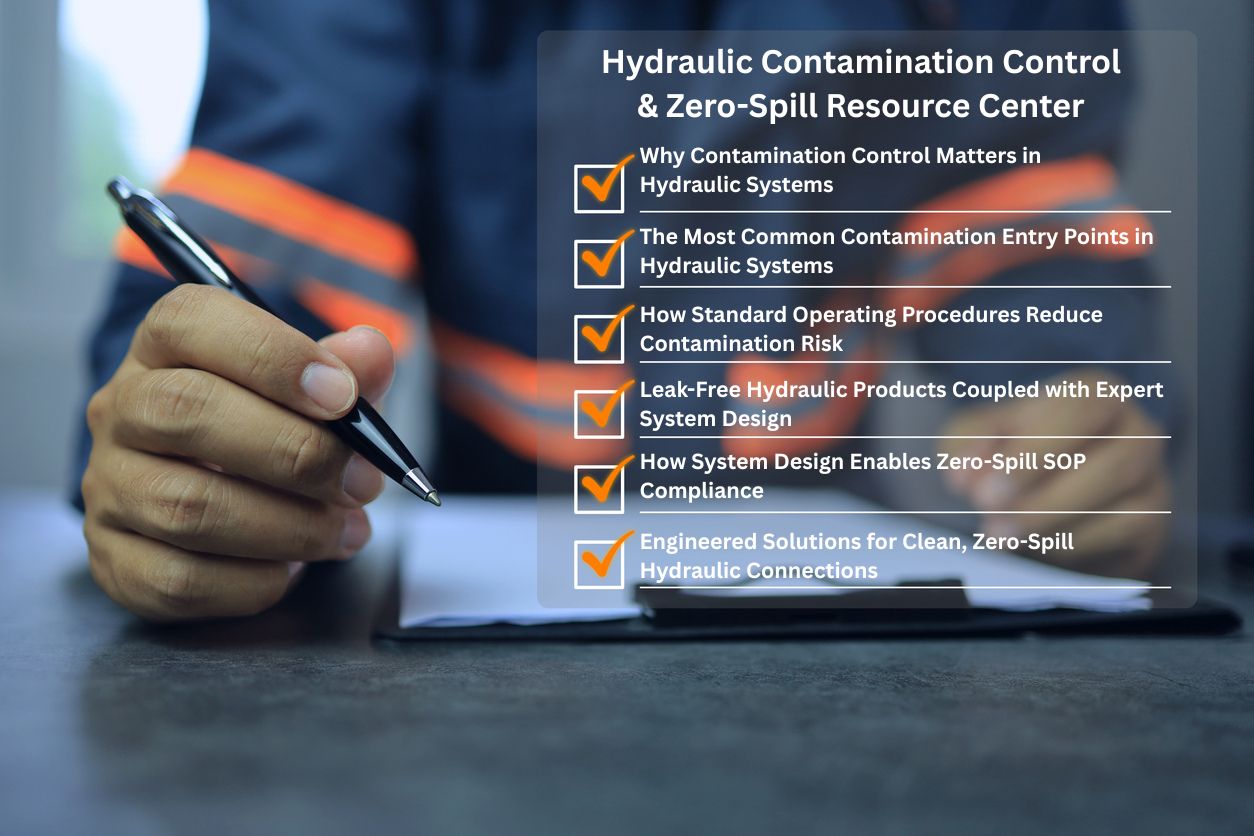 Clean hydraulic connections support safety, uptime, and long-term system reliability. Contamination can accelerate wear inside pumps, valves, actuators, and other precision components. Fluid loss can lead to cleanup costs, environmental exposure, slip hazards, and increased maintenance.
Flat-face couplers, dust caps, plugs, proper handling practices, and zero-spill connection strategies help reduce the risk of contamination at the connection interface. These practices are especially important in construction, agriculture, mining, demolition, forestry, rail, industrial, and environmentally sensitive applications where equipment operates in the presence of dust, mud, moisture, washdown, or debris.
A reliable contamination-control strategy may include:
- Flat-face couplers are designed for clean-break connection behavior
- Dust caps and plugs matched to the coupler series
- Standard operating procedures for cleaning, capping, and reconnecting
- Multi-coupling systems that reduce exposure time across multiple lines
- Connection layouts that reduce operator error and support repeatability
Explore Zero-Spill Connections & Contamination Control or review Stucchi’s Hydraulic Contamination Control Guide for deeper guidance on clean hydraulic connection strategies.
Preventing Connection Errors in Multi-Line Hydraulic Systems
 Multi-line hydraulic systems create additional safety and reliability challenges during setup, changeover, and service. A single machine interface may include pressure and return lines, case drains, electrical connectors, pneumatic circuits, water lines, oil lines, or other auxiliary media. When each line is handled individually, the process depends on access, visibility, labeling, and operator consistency.
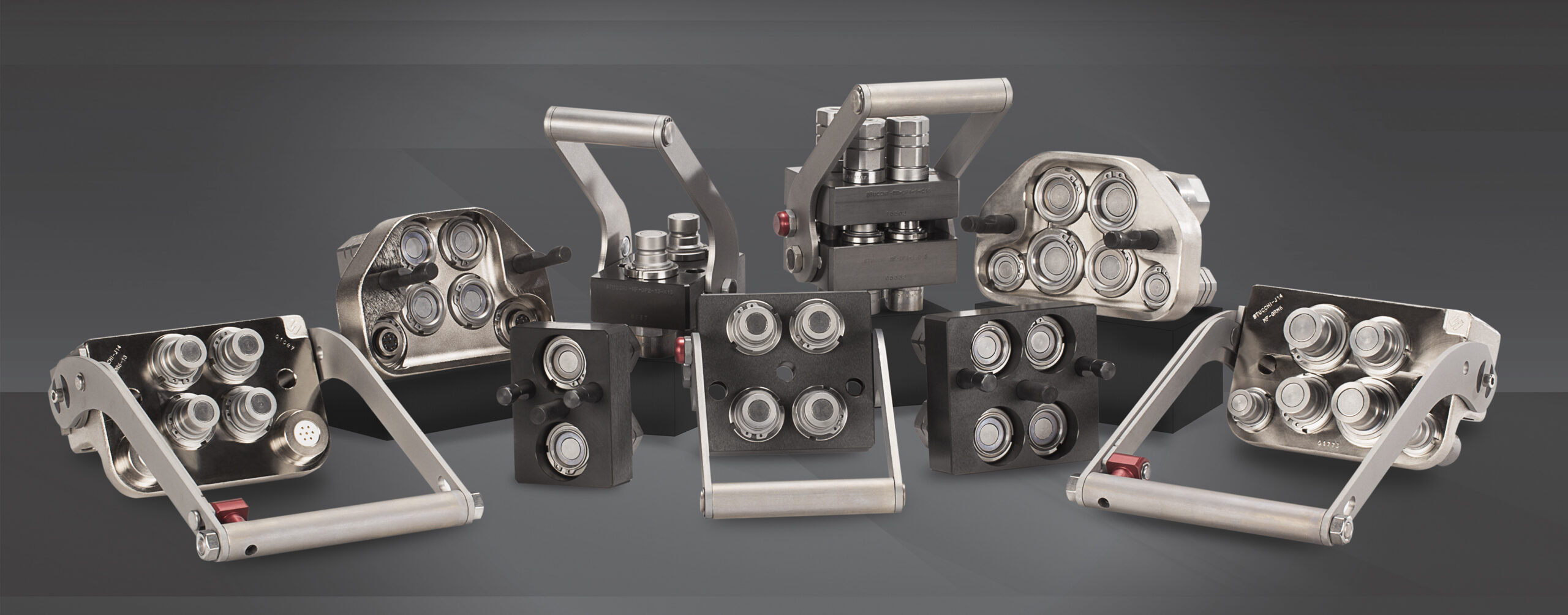
Multi-coupling plate systems reduce that variability by consolidating multiple connection points into a single guided interface. Depending on the application, Stucchi multi-coupling plates can support hydraulic-only connections, hydraulic and electrical connections, mixed-media circuits, high-flow lines, residual-pressure applications, large-diameter pressure and return lines, and custom configurations for production machinery, mobile equipment, and OEM systems.
Different plate designs support different operating needs. The DP Series supports simultaneous connection of two, four, or six hydraulic and/or electrical lines. The GR Series supports two to ten hydraulic and/or electrical lines and can accommodate different coupler sizes or media. The GRE Series supports four to 18 water, air, oil, and/or electrical lines for flexible manufacturing, die exchange, test benches, and process-control applications.
For large-diameter hydraulic lines, SV2 and BM3 plate systems support single-motion connection of two large lines, while One Position Plates support single large-diameter line applications.
This matters because safety and reliability improve when the correct connection sequence is built into the interface. Properly specified multi-coupling plates can support:
- Simultaneous connection of hydraulic, electrical, pneumatic, water, or oil lines
- Fixed port layouts that reduce cross-connection risk
- Guided alignment through pins, plates, levers, or mechanical assist features
- Reduced exposure time during attachment changes or die changes
- Cleaner connection behavior when paired with flat-face couplers
- More consistent performance across operators, machines, tools, and shifts
- Custom configurations for OEM equipment, industrial machinery, mobile attachments, and fleet standardization
A Stucchi productivity Case Study shows how this approach directly impacts uptime. In an automotive parts manufacturing application, the GRE Series multi-coupling plate helped the manufacturer achieve SMED goals by reducing die exchange time by a full six minutes. The solution improved output and cycle time by replacing multiple individual connection steps with a guided multi-coupling process.
Learn more about Multi-Coupling Solutions that Support Simultaneous Connection of Hydraulic and Electrical Lines.
Pressure Ratings, Burst Ratings, and Coupler Selection
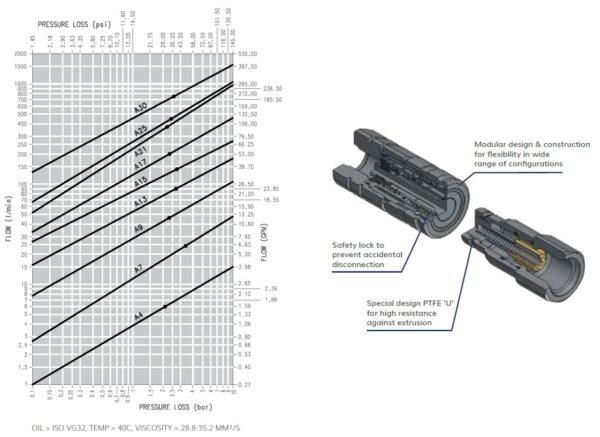 Safety and reliability depend on selecting the right coupling for the actual application, not simply matching a thread size, body size, or legacy part. Hydraulic systems may experience normal operating pressure, peak pressure, residual pressure, impulse cycles, vibration, temperature fluctuations, and environmental exposure, all of which affect connection performance.
It is important to understand several factors before selecting a hydraulic quick coupling:
- Working pressure
- Burst pressure
- Peak pressure and impulse exposure
- Flow rate and pressure drop
- Temperature range
- Fluid or media compatibility
- Connection frequency
- Operating environment
- Safety factors required by the application
A coupling that works in one application may not provide the right safety margin or reliability in another. Application review, proper sizing, and pressure-rating evaluation help ensure that the selected coupling matches the equipment, duty cycle, and operating conditions.
Review Working and Burst Pressure Ratings or use the S.T.A.M.P. Method to organize size, temperature, application, media, and pressure requirements before selecting couplers.
Reliability in Harsh and High-Duty Environments
Hydraulic reliability becomes more challenging in severe-duty environments where equipment is exposed to shock, vibration, contamination, temperature fluctuations, high-impulse cycles, and demanding flow requirements. Construction, demolition, mining, steel, agriculture, forestry, offshore, rail, industrial press, and mobile OEM applications often push hydraulic connections far beyond basic fit-and-function requirements.
In these conditions, connection reliability depends on how the coupler performs under the actual duty cycle and operating environment. Engineers and maintenance teams need to evaluate flow demand, pressure rating, residual pressure, vibration, torsion, contamination exposure, fluid compatibility, and interchangeability across machines and attachments.
Important considerations include:
- High-flow performance and pressure drop
- Seal compatibility with the fluid or media
- Material selection for corrosion, washdown, salt, or chemical exposure
- Locking mechanisms for vibration-prone applications
- Threaded or screw-to-connect designs for high-pressure systems
- Flat-face technology for contamination-sensitive applications
- Proper caps, plugs, and handling procedures during storage and transport
- Interchangeability across machines, rented equipment, and attachments

Stucchi’s Bridge Demolition case study shows why this type of application review matters. A demolition contractor working on a DOT bridge project in downtown Denver had only a 56-hour window to complete the job and faced steep hourly fines if the project ran late. Stucchi’s hydraulic specialists partnered with the demolition contractor and the equipment supplier to ensure the VEPHDL heavy-duty threaded flat-face coupler would provide complete interchangeability between the contractor’s multi-function excavator, rented equipment, and attachments. The project was completed ahead of schedule, with the VEPHDL supporting heavy hammering, attachment changeovers, and leak-free performance in a demanding demolition environment.
Explore High-Flow Hydraulic Coupler Solutions, review Hydraulic Pressure Drop, or contact the Technical Help Desk for severe-duty application support.
Fleet Standardization and Lifecycle Reliability
Safety and reliability improve when hydraulic connection systems are standardized across machines, attachments, operators, and maintenance practices. Mixed fleets, legacy couplers, inconsistent attachment interfaces, and non-standard connection practices can increase downtime and operator confusion.
Fleet standardization helps teams create repeatable connection behavior across equipment.
 A standardized hydraulic connection strategy can support:
- Easier replacement planning
- Reduced operator confusion
- Better compatibility across machines and attachments
- Cleaner connection practices
- More consistent maintenance procedures
- Reduced risk during attachment changes
- Improved uptime across the equipment lifecycle
This is especially important for OEMs, rental fleets, distributors, and large equipment operators managing multiple machine platforms, attachment brands, or generations of hydraulic systems.
Explore OEM and Engineering Solutions or submit a request through the Technical Help Desk for application-specific support.
Safety & Reliability Resources
The resources below provide additional guidance on connection technologies and engineering practices that support safer, more reliable hydraulic systems.
Pressure Management & Connect Under Pressure – Learn how connect-under-pressure couplers support safer connections under residual pressure and reduce unsafe workarounds during attachment changes.
Zero-Spill Connections & Contamination Control – Explore how clean-break connections, flat-face couplers, caps, plugs, and operating procedures reduce fluid loss and contamination risk.
Multi-Coupling Plate Systems – Review connection systems that help reduce cross-connection risk and simplify multi-line changeovers.
Working and Burst Pressure Ratings: Understand the relationships among working pressure, burst pressure, peak pressure, and safety factors.
S.T.A.M.P. Coupling Selection – Use size, temperature, application, media, and pressure to organize coupling selection requirements.
Technical Help Desk – Submit photos, CAD files, pressure data, flow requirements, or troubleshooting details for engineering support.
Build Safer, More Reliable Hydraulic Connection Systems
 Safety and reliability depend on how hydraulic connections perform in real operating conditions.
The right strategy accounts for pressure behavior, exposure to contamination, flow requirements, connection frequency, operator workflow, and the environment in which the equipment runs.
Stucchi helps OEMs, equipment manufacturers, distributors, and fleet teams evaluate connection challenges, improve compatibility, reduce risk, and develop hydraulic connection systems that support uptime across the equipment lifecycle. Contact the Stucchi Technical Help Desk to evaluate your hydraulic connection challenge and build a safer, more reliable system strategy.
Stucchi engineers hydraulic connection solutions designed to support safety, reliability, contamination control, and uptime in demanding hydraulic applications. Our hydraulic specialists help OEMs, equipment manufacturers, distributors, and fleet teams evaluate pressure, flow, compatibility, connection integrity, and lifecycle performance. Contact Stucchi to build a safer, more reliable hydraulic connection strategy.