




Table of Contents
- 1 Flat-Face Couplings: Supporting Zero-Spill Connections for Contamination Control
- 2 ISO 16028: How Stucchi’s Flat Face Design Set the International Standard
- 3 Stucchi Flat-Face Couplers for Demanding Hydraulic Applications
- 4 Flat-Face vs. Poppet Couplers: What’s the Difference?
- 5 Why Zero-Spill Hydraulic Connections Matter for Environmental Protection
- 6 Supporting Clean Hydraulic Connections with Complete System Solutions
- 7 Common Questions About Flat-Face Couplers
- 8 Engineering Hydraulic Connection Systems for Contamination Control
Flat-Face Couplings: Supporting Zero-Spill Connections for Contamination Control

Hydraulic contamination frequently begins at the connection interface. Each time a hydraulic circuit is opened, during attachment changes, maintenance, or equipment transport, the coupling becomes exposed to the surrounding environment. Dust, debris, moisture, and air can enter the system at that moment, while poorly designed connections may also release hydraulic fluid during disconnect.
Modern hydraulic systems require connection technologies that address both risks simultaneously: preventing contamination from entering the circuit and minimizing fluid loss during connection and disconnection.
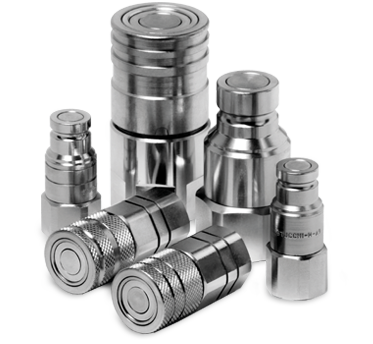
Flat-face hydraulic couplers were developed to meet these challenges. Their flush mating surfaces and clean-break valve design help reduce exposure to contamination and support zero-spill hydraulic connections across mobile equipment, industrial machinery, and OEM hydraulic systems.
For a broader system-level overview of hydraulic cleanliness, including connection technology, protective accessories, and operating procedures, see Stucchi’s Hydraulic Contamination Control Guide, which explains how these elements work together to protect hydraulic systems.
Why Connection Interfaces Are the Most Vulnerable Point in Hydraulic Systems
 Hydraulic systems rely on filtration to remove contaminants from the circulating fluid. However, contamination introduced during connection events can begin circulating through pumps, valves, and actuators before it is captured by filtration.
Connection interfaces are especially vulnerable because they are repeatedly exposed to the environment during normal operation.
Common contamination entry points include:
- Attachment changes on excavators, skid steers, and agricultural machinery
- Hose disconnection and reconnection during maintenance
- Transport or storage of equipment with uncapped couplers
- Residual pressure events that complicate reconnection
- Environmental exposure to dirt, moisture, or debris
Each of these moments creates an opportunity for contaminants to enter the system or for hydraulic fluid to escape.
Flat-face couplers help reduce these risks by redesigning the connection interface to enable cleaner, more controlled connection behavior.
How Flat-Face Couplers Reduce Fluid Loss and Contamination
Traditional poppet-style couplers contain recessed internal cavities that trap hydraulic fluid when disconnected. These cavities can also collect debris that may later enter the hydraulic circuit during reconnection.
Flat-face couplers eliminate many of these vulnerabilities.
Instead of recessed pockets, the mating surfaces are flush and smooth, allowing the two coupling halves to seal directly against each other. Internal valves close before the connection separates, helping contain hydraulic fluid within the system.
This design supports contamination control by:
- Minimizing trapped fluid volume
- Providing smooth surfaces that are easy to wipe clean
- Reducing debris accumulation points
- Limiting fluid release during disconnect events
Because of these characteristics, flat-face couplers are widely used in environments where hydraulic cleanliness and environmental protection are critical, including construction, agriculture, demolition, and mobile hydraulic equipment.
ISO 16028: How Stucchi’s Flat Face Design Set the International Standard

As flat-face hydraulic coupling technology gained widespread adoption, the need for interchangeability between equipment manufacturers became increasingly important. The International Organization for Standardization established ISO 16028, which defines dimensional requirements and performance characteristics for flat-face hydraulic couplers used in many mobile and industrial applications.
ISO 16028 enables couplers from different manufacturers to connect reliably while maintaining the clean-break characteristics that make flat-face technology valuable in contamination-sensitive hydraulic systems.
Couplers designed to ISO 16028 typically support:
- Reduced fluid loss during connection and disconnection
- Lower air inclusion when reconnecting hydraulic circuits
- Improved contamination control at the coupling interface
- Interchangeability across machines, attachments, and equipment brands
Stucchi played a significant role in the development of flat-face coupling technology, which ultimately shaped the ISO 16028 standard. Today, the design principles pioneered by Stucchi are widely recognized across the industry.
Learn more about how Stucchi’s flat-face coupling design became the ISO 16028 international standard.
Stucchi Flat-Face Couplers for Demanding Hydraulic Applications
Stucchi manufactures a range of flat-face couplers engineered for durability, contamination control, and reliable hydraulic performance across demanding environments.
These product families support different pressure ratings, flow requirements, and machine configurations while maintaining clean-break connection characteristics.
| Stucchi Series | Typical Application | Key Characteristics |
|---|---|---|
| A Premier Series | Heavy-duty mobile equipment | High pressure ratings, strong flow performance, ISO 16028 interchange |
| FIRG Series | Construction and mobile hydraulics | Durable flat-face design |
| APM Series | Compact hydraulic equipment | Lightweight flush-face coupler |
| A-HD Series | High-pressure systems | Designed for demanding hydraulic circuits |
| Push-Pull Series | Equipment with frequent attachment changes | Allows connection and disconnection under load |
| FIRGQ Series | Rapid connection applications | Heavy-duty flat-face design |
| FL Series | Industrial and mobile systems | Contamination-resistant coupling |
| A-SK Series | Aerospace and Skydrol fluid systems | Specialized fluid compatibility |
Stucchi’s A Premier Series Flat-Face ISO 16028 couplings are designed for applications requiring higher pressure ratings, strong flow characteristics, and minimal pressure drop.
The series is engineered for zero-spill hydraulic performance, helping to limit exposure to contamination while avoiding fluid loss during connection and disconnection. An international version is available with British BSP or German DIN port options for global equipment compatibility.
Flat-Face vs. Poppet Couplers: What’s the Difference?
Flat-face couplers and traditional poppet couplers perform the same basic function: connecting hydraulic circuits, but their internal valve designs affect exposure to contamination and fluid loss differently.
| Feature | Flat-Face Couplers | Poppet Couplers |
|---|---|---|
| Valve design | Flush mating surfaces | Recessed poppet valve |
| Fluid loss during disconnect | Minimal clean-break release | Small fluid release typical |
| Contamination exposure | Smooth surfaces easier to clean | Debris may collect in recessed cavities |
| Maintenance visibility | Easy inspection of the sealing surface | Contamination harder to detect |
| Typical applications | Mobile equipment, agriculture, and construction | General industrial hydraulics |
Because flat-face couplers minimize exposed cavities and contain hydraulic fluid during disconnect, they are widely selected for applications where contamination control and environmental protection are operational priorities.
Why Zero-Spill Hydraulic Connections Matter for Environmental Protection
Hydraulic fluid leaks affect more than equipment performance. In many industries, fluid loss can create environmental and regulatory challenges.
Equipment operating near waterways, agricultural land, infrastructure projects, or sensitive environments must minimize the risk of fluid release. Even small leaks can trigger cleanup costs, regulatory reporting requirements, or operational delays.
Zero-spill connection technology helps reduce these risks by controlling fluid release during disconnect events. Flat-face couplers contribute to this strategy by supporting clean-break hydraulic connections that limit fluid escape when lines separate.
Reducing fluid loss also helps operators:
- Maintain cleaner worksites
- Reduce hydraulic fluid consumption
- Lower maintenance and cleanup costs
- Support environmental compliance requirements
Supporting Clean Hydraulic Connections with Complete System Solutions
 Flat-face couplers are a critical component of contamination control strategies, but they are most effective when used as part of a complete hydraulic connection system.
A comprehensive contamination control approach may include:
- Flat-face couplers for clean-break connections
- Dust caps and plugs that protect exposed interfaces
- Standard operating procedures for clean connection practices
- Pressure-management solutions that prevent forced connections
- Multi-coupling plate systems that connect several circuits simultaneously
For a deeper look at how these elements work together, Stucchi’s Hydraulic Contamination Control Guide explains how operators and OEMs can design systems that protect hydraulic circuits from contamination.
Multi-Coupling Plates and Integrated Connection Systems
Multi-coupling plates allow operators to connect multiple hydraulic lines in a single motion while maintaining leak-free flat-face connections. This significantly reduces connection errors and limits exposure to contamination during attachment changes.
When connection technology, protective accessories, and operating procedures work together, hydraulic cleanliness becomes repeatable rather than dependent on ideal conditions.
Common Questions About Flat-Face Couplers
How do I know when seals on a flat-face coupler need to be replaced?
 Flat-face coupler seals can wear over time, particularly in applications with frequent connection cycles. Signs that seals may need replacement include hydraulic fluid leakage, reduced sealing performance, or visible wear on the sealing surface.
In many cases, replacing the seals can restore proper coupler performance and extend service life. Stucchi recommends servicing the male coupler seals, as repairing the female valve assembly is typically more complex.
See the step-by-step guide and video demonstration:
How to Replace the Seals on a Flat-Face Coupler
Why are flat-face couplers easier to keep clean than poppet couplers?
Flat-face couplers use flush mating surfaces that can be quickly wiped clean before reconnection. Traditional poppet couplers have recessed cavities that can trap debris, making them harder to clean and increasing the risk of contamination during reconnection.
Can flat-face couplers connect under residual pressure?
Some flat-face couplers support connect-under-pressure (CUP) capability. These designs allow operators to connect hydraulic lines even when residual pressure remains in the circuit.
Residual pressure can develop due to thermal expansion, trapped pressure after shutdown, or load-induced pressure in attachments. CUP-enabled couplers incorporate internal pressure-relief mechanisms that allow connections to be made without forcing the coupler or venting fluid externally.
Engineering Hydraulic Connection Systems for Contamination Control
Hydraulic contamination control is most effective when it begins at the connection interface. By reducing exposure to contamination and limiting fluid release during connection events, flat-face couplers help maintain cleaner hydraulic systems and more reliable equipment operation.
Stucchi continues to develop coupling technologies designed for demanding industries where hydraulic reliability, contamination control, and environmental protection are essential. From heavy-duty mobile equipment to specialized hydraulic applications, these couplers help operators maintain cleaner connections, reduce downtime, and support long-term hydraulic system performance.
Stucchi engineers hydraulic connection solutions designed to support contamination control, zero-spill performance, and reliable equipment operation. Our hydraulic specialists work with OEMs, dealers, and fleet operators to develop coupling systems that improve interchangeability, reduce fluid loss, and enhance hydraulic system reliability. Connect with a Stucchi hydraulic engineer now to discuss your hydraulic application and design a connection solution that supports contamination control and zero-spill performance.
