




Table of Contents
- 1 How Do Hydraulic Quick Coupler Caps Support Contamination Control?
- 2 Why the Coupler Interface Is a Primary Contamination Entry Point
- 3 How Dust Caps Help Prevent Debris from Entering the Hydraulic Circuit
- 4 Preserving Sealing Integrity and Zero-Spill Performance
- 5 Why Industry Treats Dust Caps as a Contamination Control Standard
- 6 Where Dust Caps Matter Most Across Operating Environments
- 7 Best Practices for Specifying and Using Hydraulic Quick Coupler Caps
- 8 Dust Caps as Part of an Integrated Contamination Control Strategy
- 9 Engineer Zero-Spill Contamination Control into the Hydraulic System
How Do Hydraulic Quick Coupler Caps Support Contamination Control?
Quick Answer: Hydraulic quick coupler caps support contamination control by sealing exposed connection interfaces during disconnection, storage, and idle periods. By protecting sealing surfaces from dirt, moisture, and debris, dust caps help preserve zero-spill performance, prevent contaminants from entering the hydraulic circuit upstream of filtration, and support long-term hydraulic system reliability across mobile, industrial, OEM, and fleet equipment.
Why the Coupler Interface Is a Primary Contamination Entry Point
Contamination control is most effective when it begins at the point where hydraulic systems are most exposed: the connection interface. Each time a hydraulic quick coupler is disconnected, such as during attachment changes, maintenance, transport, or storage, critical sealing surfaces and internal valve components are briefly open to the surrounding environment. Contaminants introduced during these moments often bypass filtration entirely and are carried directly into the hydraulic circuit at reconnection.
How Dust Caps Help Prevent Debris from Entering the Hydraulic Circuit
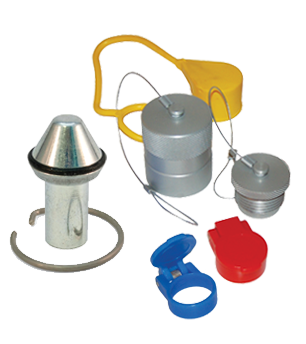 Quick couplers are designed for efficiency, enabling fast attachment swaps and flexible machine use. That same convenience creates frequent open-system events, making the coupler interface one of the most common and most overlooked entry points for contamination.
When couplers are left uncapped, debris accumulates on sealing faces and valve components. At reconnection, those contaminants are pushed directly into the circuit, where they can circulate repeatedly and accelerate wear in pumps, valves, and actuators.
Quick coupler dust caps act as a physical barrier during idle periods. They protect the interface when exposure risk is highest, between operating cycles, reducing the amount of debris that can enter the system at reconnection.
Preserving Sealing Integrity and Zero-Spill Performance
Modern flat-face hydraulic couplers rely on clean, undamaged sealing surfaces to achieve zero-spill connection and disconnection. Even small amounts of grit or moisture can compromise sealing integrity, resulting in leakage, pressure instability, or seal degradation over time.
Dust caps help preserve sealing surfaces by preventing contamination from reaching critical contact areas. Clean interfaces allow flat-face couplers to connect and disconnect as designed, supporting controlled pressure transitions, minimizing fluid discharge, and maintaining consistent zero-spill performance.
From an engineering standpoint, dust caps are not just protective covers. They are an enabling component that helps zero-spill coupling technology perform reliably over the life of the system.
Why Industry Treats Dust Caps as a Contamination Control Standard
Across mobile equipment, industrial machinery, and OEM hydraulic platforms, industry experts consistently identify uncapped ports and coupler faces as high-risk contamination pathways. Sealing exposed connections immediately after disconnection is widely recognized as a best practice to protect hydraulic cleanliness, because contaminants introduced at the coupler interface can enter upstream of filtration and circulate through the system, increasing wear and reducing reliability.
Industry guidance, such as this article from Fluid Power World, emphasizes that protective caps and plugs are critical tools to guard hydraulic ports and fittings against dirt, moisture, corrosion, and damage, reinforcing their role in contamination control and system reliability.
Where Dust Caps Matter Most Across Operating Environments
 While contamination risks exist in all hydraulic applications, environmental exposure varies by use case:
- Construction and earthmoving: Dust, mud, and abrasive debris during frequent attachment changes
- Mining and heavy industry: Fine particulates and harsh operating conditions
- Agriculture and municipal fleets: Dirt, moisture, and seasonal exposure during idle periods
- Industrial manufacturing: Cleanliness requirements for precision components and repeatable performance
Across these environments, the role of dust caps remains the same: reducing exposure during disconnection and supporting a cleaner, more controlled hydraulic circuit.
Best Practices for Specifying and Using Hydraulic Quick Coupler Caps
To maximize contamination-control benefits, dust caps should be incorporated into the hydraulic system design, not treated as an afterthought. Best practices include:
- Cap couplers immediately after disconnection
- Use purpose-built caps sized for the specific coupler series
- Tether or retain caps to prevent loss and encourage consistent use
- Keep caps clean and replace damaged caps promptly
- Wipe coupler faces before reconnection, even when caps are used
These practices are most effective when formalized within operating procedures and supported by engineering-led system design.
Dust Caps as Part of an Integrated Contamination Control Strategy
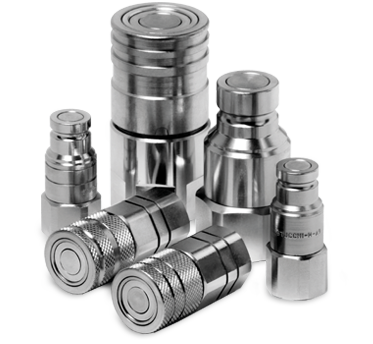 Dust caps alone do not prevent contamination. Their value is realized when they are combined with flat-face couplers, connect-under-pressure technology, and disciplined system-level specification. For OEMs and fleet operators, contamination control is most effective when it is engineered into the hydraulic system from the start. That includes selecting connection technologies, accessories, and operating practices that work together to reduce fluid loss, prevent debris ingress, and support predictable uptime.
Viewed in this context, dust caps are not minor accessories. They are a foundational component of a zero-spill, contamination-controlled hydraulic connection strategy. When specified alongside flat-face couplers, connect-under-pressure solutions, and disciplined system design, dust caps support cleaner connections, longer component life, and more predictable uptime across demanding applications.
Contact Stucchi at our Technical Help Desk to upload drawings and connect with an experienced hydraulic engineer.
Engineer Zero-Spill Contamination Control into the Hydraulic System
Hydraulic contamination control is most effective when it is engineered into the system rather than managed after failures occur. By protecting exposed connection points, hydraulic quick coupler caps help preserve sealing surfaces, support zero-spill performance, and reduce the introduction of debris during attachment changes and idle periods.
When combined with flat face coupling technology, disciplined specification methods, and consistent operating practices, dust caps play a measurable role in extending component life, improving reliability, and maintaining clean, dependable hydraulic systems.
Stucchi engineers hydraulic connection solutions for demanding mobile and industrial equipment applications. We deliver flat-face quick couplers, connect-under-pressure technology, multi-coupling systems, and contamination-control accessories designed to protect system performance and uptime. Contact us today to build a hydraulic connection strategy that supports contamination control and zero-spill operation.
